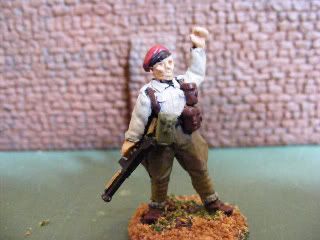
Sunday, 9 January 2011

Cookery, part 2

Baked Soup
1 lb any kind of meat, any trimmings or pieces.
2 onions,
2 carrots,
2oz of rice,
1 pint of split peas,
Salt and pepper to taste,
4 quarts of water,
Cut the meat and vegetables in to slices, add them to the rice and peas, season with salt and pepper. Put the whole lot in a jar, fill up with the water, cover very closely and bake for 4 hours.
I think this is a great way of using up leftovers and cooking them when cooking something else.


Homity pie
A traditional English open vegetable pie, the pastry case contains a potatoes and an onion & leek mixture, which is then covered with cheese - (apple adds interest, but isn't traditional).
Equipment needed:
Ingredients for 6 individual or 1 larger pie:
6 individual pie tins or foil dishes, or 1 x 8 in flan dish
10 oz Short crust Pastry
12 oz Potatoes, peeled
½ lb Onions, peeled and roughly-chopped
½ lb Leeks, carefully-washed - then cut into pieces
3 tablespoons Vegetable Oil
2 medium cloves of Garlic, peeled and finely-chopped
2 Crisp Dessert Apples (red if possible), cored and cut into pieces - but the skin left on
4 tablespoon Milk or Single Cream
2 Eggs, lightly-beaten
1 oz Butter (plus a little to line the pie tins)
a small bunch of fresh Parsley
a large pinch a Thyme
10 oz grated Cheddar Cheese
Salt and freshly-ground Black Pepper to taste
a pinch of Cayenne Pepper
Lightly butter the pie tins.
Roll out the pastry and line the pie tins. Chill the tins while you make the filling.
Boil or steam the potatoes until they're tender - then chop them into bite-sized pieces.
Sauté the chopped onions and leeks over a gentle heat in the vegetable oil, until they're soft. Add the apple pieces and mix in.
Add the garlic, followed by the potatoes, butter, parsley and thyme, the eggs, half the cheese and the milk.
Season with salt and pepper and combine the mixture well together.
The pies can be prepared in advance up to this stage.Fill the pies and cover them with the remaining cheese.
Bake them in a pre-heated oven 220C/425F/Gas 7, for 20 minutes, or until golden.
Serve warm or cold.
I had it cooked in a cake tin, so got a large deep slice.
 

Sunday, 26 December 2010

1938 Project, part 3

I don't have much in the way of tools. A saw, 2 knives, drill, file that’s about it.
If I change a rifle I always start with the left hand thumb and cut this away from the rifle. I then cut the rifle off the figures left hand.
I then drill down through the rifle as far as I can. This makes it easier to cut out. Then I cut out the rest of the rifle from between the hands.


I then cut the butt off the new rifle and shape it to fit in to a hole in the right hand and in to the left.
Thr hats I just cut a notch in the side of the one to be cut off with a knife. This gives me a start for the saw.
Then I just cut through, file off any ruff edges and glue on a British helmet.

Wednesday, 22 December 2010

The Anglican League in Cornwall

The betrayal and collapse of the Anglican League in Devon also meant the collapse of the Anglican League in Cornwall. With no outside support they had no choice but to fall back to an area they could defend and one in which they could be supported and supplied. They choose Bude on the North Cornwall coast.
The town had been a holiday resort before the civil war started, so it had several large hotels and a lot of guest houses. These were taken over the Anglican League and their families. They set up their headquarters in the fort, next to the harbour.
The town itself has a rail line running east and a harbour capable of taking ships up to 300 tons. This sea link was vital to the survival of the Cornish Anglican League.
The countryside around Bude lent itself to a defensive battle, the bank hedges making excellent fighting positions.
With the fighting in Devon in the south of the county the Cornish Anglican League pushed east as the Devon Anglican League pushed west until they met up at Monkleigh. The capture of Bideford gave the Anglican League three harbours along the coast and a large number of boats and small ships. These were used to move troops up and down the coast which was quicker than the roads.
With no deep water port to the west of Bristol, the government had great difficulty in controlling smuggling and gun running along the North Somerset, Devon and Cornish coasts.
Coast watching became a major operation for all sides. Many locals hoped to make money from any craft driven ashore by bad weather or by enemy action. Wrecking has become a major money maker along the coast.
Even the Anglican League have taken to piracy, and have a squadron of fast boats always ready for action. Their biggest ‘catch’ was the Italian cargo ship the MV Augusta…

Saturday, 18 December 2010

1938 Project, part 2


Here are photo's of the 3 finished figures.
I'll post photo's and a write up of my technique later.

Sunday, 12 December 2010

Tring Fluff

The is the first draft for the Tring game. What do you think?
Background
After the fighting in West Somerset faded away no side was left with an advantage. The Royalist press feted Col. Dunbar as a Hero at the expense of Capt Cunningham Smyth of the BUF. This undermined relations between the BUF and the Royalists as the BUF
The King added insult to injury by getting one of Col. Dunbar’s Catholic companies moved to Bridgwater. The BUF in Bridgwater now under the command of Oliver Cunningham-Smyth ( the Captains younger brother) nearly mutinied when they heard this.
The Anglican League came off quite badly in the fighting, losing Axbridge. They now hope to take advantage of the BUF and Royalists mistrust and regain the initiative. They are looking for a new target.
The Somerset Freedom Fighters may have failed to take Cheddar, but they did cut the A38 from Churchill to Cross. They aim to use the split between the BUF and Royalists to their advantage.
The Royalist Catholic company took nearly two weeks to arrive in Bridgwater, as in the end they had to come by sea. This meant
they had no vehicles and couldn’t get any from the BUF, who claimed they had none spare.
The Royalist company was lead by Capt. Stanley Horne. He had fought with Col. Dunbar during the attack on Axbridge and had been promoted at the same time as the Colonel. Stanley Horne was now a pinup for the Royalist press, with his blond hair and blue eyes, looking out from under a red Carlist beret.
The SFF took advantage of the lull to retake Westonzoyland and positions on the Polden’s, overlooking Bridgwater.


Anyone looking at a map can see that the main road and railway from Bridgwater to Weston-Super-Mare crosses 4 rivers; the Axe, Brue, Huntspill and the Kings Sedgemoor Drain. Guarding all these bridges was a major drain on BUF and now Royalist forces in north Somerset.
The Anglican League have decided to try and clear the SFF from Shapwick Heath which is very close to Glastonbury. The areas under there control were getting squeezed and the Anglican League had to come out fighting.
The Anglican League had had one piece of good luck. The platoon left behind in Burnham on Sea had gone underground and was still in position even though the BUF now controlled the town. If the Anglican League could get them supplies and reinforcements a new front could be opened.
s version of events was very different from the Royalist one.

Saturday, 11 December 2010

1938 Project, part 2


The rifles and helmets arrived from Assult Group today and I had these 3 laying
 about.

1938 Project

I’m planning a 1938 project for Christmas, I was going to use Warlord Germans, but the cost for 25 figures is just to much.
So I’m going to use Empress SCW figures. I’ve use these before so I know what to expect. This time I want to change some of the rifles as well to make them look more ‘British’. I also have to do some of J’s Catholic Royalists for the Tring game. These look like SCW Carlist’s, but I want to give them a ‘British’ look with Lee Enfield’s rifles, Webley pistols and some 37 pattern webbing even a Tommy gun. I’ll post some pictures before I get started. Some of these I've done for Bob in America.